Summer season finally over

With the exception of a band concert on the beach on Saturday my summer schedule of weekly rehearsals followed by weekly concerts for both of the bands I’m in is finally over. Phew. Add to that my trips to IHS and the Barry Tuckwell Institute (BTI) it’s been quite a summer. Then there’s the weekly lessons with Lynn and the monthly lessons with Scott Bacon. I have not had much time to actually practice.

My drive back in June from IHS took longer than it should have so I didn’t play my horn for about six days. That resulted, strangely enough, in a big improvement in my playing ability. This improvement lasted for a week or two and then I went to the BTI. I had a fabulous time there but since then my chops have been shot. I have not recovered yet from playing for more than three hours each day.

I’ve tried cutting back my playing time to about an hour from my previous, before BTI, two hours of daily practice. I’ve skipped days here and there. I’ve spent a lot of time practicing long, low notes and easy arpeggios. Nothing is really helping. I’m pretty sure that my band schedule isn’t helping the situation because we play fff almost all the time. Rehearsals run from an hour and a half to two hours and the concerts are an hour.

I’ve managed to barely maintain the level of technical capability I reached since IHS but my tone is pretty bad. It’s fuzzy and screechy. This is my typical problem when I’m having a bad day and I know I’ve mentioned it many times before. Then there are days when I just can’t play anything. I’ve always had bad days here and there, even two or three in a row. I think this current spell of bad days sets a record for me. It’s been three and a half weeks of poor to mediocre playing and no endurance. I’m dealing with this pretty well I think. I’m not rushing out to change mouthpieces or trying to find some gadget that will cure all. I haven’t changed my warmup routine. I’m more annoyed than frustrated. Enough already with this.

I am hoping that when I get back into my normal routine of practicing that this bad spell will get go away.  It’s way more fun to practice when I’m playing at the level of my expectations. If another week goes by without any improvement then I’ll have to dive deeper into what’s going on. Right now I’m still calm.

Expectations –>

Chops etcetera

I am still dealing with some chops issues. It seems to be an inconsistent problem  – Monday no good, Tuesday so-so, Wednesday fine, Thursday awful, Friday back to so-so. Thursday was so bad – couldn’t play anything below middle C that didn’t sound like my dog farting – that yesterday Lynn, my horn teacher, and I worked on long tones and easy slurs for about half my lesson. I would describe my lip as squirrelly. Sometimes it was okay and other times the lower notes were right on the edge of my upper lip failing.

I’m much better at dealing with this sort of stuff now than I was several months ago. I know that I have good days and bad days and that ultimately I will play even better because that always seems to be the pattern. I go through bad spells and then miraculously I get a lot better. It’s frustrating going through the bad spells now mostly because I don’t accomplish what I want to when I’m practicing. When my chops aren’t behaving everything gets sloppy, including me. Today Lynn noticed that I was slouching in my chair and not breathing properly. I didn’t realize it but I was in the mode of ‘I’m playing sucky, so I’ll just sit sucky and breathe sucky too.’ We did some stretching exercises and some breathing exercises which helped my playing quite a bit and my attitude a whole lot. There’s nothing like sitting up straight to refresh one’s brain.

BERP

BERP

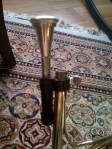
At today’s lesson I also worked with a BERP (Buzz Extension Resistance Piece). Lynn recommended it way back when I first started lessons but at that time I could hardly buzz so the BERP got put into a drawer and forgotten about. What a difference now. I played arpeggios on the BERP first and then played them on the horn. They were instantly better. It was a wow moment. Much smoother and louder. I have problems playing loud so now I have a tool that can help with that and a whole lot more. When I first bought the BERP I didn’t really understand what the point was. Now I get it. Big time. The BERP has earned its place on my leadpipe and will remain there. It’s a good gizmo!

Speaking of gizmos, when I was at IHS I bought a stem weight, also called a donut, from Tom Greer. According to Tom’s website it “cuts down on the ‘radiation’ of high partials from the leadpipe, enhancing projection and tone quality.” When I tried it at IHS Tom said I sounded more centered. I use it more often than not and I do think it makes a positive difference though it’s subtle. They come in different sizes so if you get one make sure it fits on the mouthpiece.

I also purchased a Body Beat metronome back in May. Those of you who have read some my earlier posts know that I can easily block out the beat of the metronome which is especially bad for me since rhythm is not one of my strong suits. The Body Beat sends a pulse down a wire that is clipped on to clothing next to the body so you can feel the beat. This actually helps me a lot. At my last lesson with Scott Bacon at the end of June he said my rhythm was the best he’d heard it. It is a bit of a pain in the butt to use and it’s gone flying off the music stand if I get up and forget to unclip it. I think it’s a good tool for anyone struggling with a standard metronome.

Blog not –>

An interesting month

It’s been almost a month since I left by car for IHS. Before the trip I was extremely diligent with my practicing. I don’t think I missed more than a day or two since mid-January. I built up my endurance so that I could practice around two hours everyday. Once I left for Macomb all of this changed.

During my drive I didn’t have time for two hours of practice and I found practicing in hotel rooms difficult. With the practice mute it was weird and very boring. Without the mute I felt uncomfortable because I don’t play very well yet and I didn’t want anyone to hear me. Consequently, my two hours of practicing went out the window.

Once I got to Macomb I did get a lot of playing in but not a lot of actual practicing in. I don’t really have the endurance yet to go to warm-up sessions and then the ensembles and try out horns and still practice. I wrote about my extended drive back home with no practicing in ‘Oops‘ and about the first several of days of practice after I got home in “Recovery.”

This brings us to the middle of last week and my daughter’s wedding this past Sunday. I did not have a lot of time for practicing. To say my life was hectic would be quite an understatement. All four of my kids were home, there were a million errands to run and I had to clean up the house for the after wedding barbeque that we were hosting. My horn got put away in it’s case (“Mom, can’t you put your stuff away now? (Notice the parent / child reversal)), music was put back into the piano bench, the stand relocated into the laundry room – out of site, out of mind. I did manage to get a bit of practicing done but nowhere near as much as I would have liked.

Obviously no practicing happened on the day of the wedding. The hairdressers showed up a 6 am at my house and my time was scheduled right up to leaving for the ceremony. My daughter actually created an excel spreadsheet for the schedule with times listed down to 5 minutes. (e.g. – Mom’s hair – 6 am; mom’s makeup 6:25 am; mom’s nails 6:35 am, maid-of-honor hair 6:20 am, and so on.) Fortunately the wedding was wonderful and there were no hiccups. For any of you that are interested the pictures are at http://www.flickr.com/photos/abarkan283/sets/72157620369929574/. There’s a picture of me walking down the aisle with my oldest son here: http://www.flickr.com/photos/abarkan283/3653088529/in/set-72157620369929574/.

I didn’t practice Monday or Tuesday either because I had band rehearsals both nights. I’ve learned that I can’t practice anything more than warmups before two non-stop hours of rehearsals. Then Wednesday I had a lesson in the morning and I played duets with a friend for two hours in the afternoon. My lesson clearly reflected the fact that I hadn’t practiced much. Many of the exercises that we worked on the week before didn’t go as well yesterday. Plus, my brain was not engaged. I couldn’t transpose down an octave at all and this is something that I can usually do without any problems. It was so bad all I could do was laugh. Maybe it was because we had started working on Eb transposition first that caused the brain fog. The duets in the afternoon went better than my lesson but again, not as good as I have played previously. I did have a lot of fun though and that’s more important to me than missing notes.

Today I finally got to practice. It had been so long that I had to remind myself what my usual routine was. I had to go searching for the metronome (found it, darn) and my tuner. I started out with my usual warmups and then moved on to the Singer embouchure exercises and then Kopprash #2. The good news is that I played these really well, even the Kopprash and that’s a really rare event. I worked on Basler’s Conciones and Struass 1 and was surprised at how well I played them. I practiced for about an hour and 15 minutes in the morning and then again for another hour in the late afternoon. I didn’t have any problems with endurance so I had to make myself stop. It’s hard to do that when everything is clicking so nicely.

Tomorrow is another totally normal, uninteresting day (all the kids have left and peace and quiet has returned to the house) so I will practice again for my usual two hours. I really, really hope I have another good day.

Bowling… –>

Traveling

I’m on my way to the International Horn Symposium by car so I have several nights in hotels on my way. I’ve never used a practice mute before. I borrowed one (Yamaha silent brass mute without the electronics) and used it for the first time two days ago. It was weird. Very, very weird. The first thing – how to hold the horn. The mute takes up all the space in the bell. No room for a hand. This is pretty obvious but it didn’t occur to me until I stuck the mute into the bell. I tried holding on to the end of the mute, holding the edge of the bell, shoving my elbow against the mute – nothing really worked.

The second thing – really bad posture which is a consequence of the the hand problem. I found myself fairly hunched over once I found a somewhat comfortable place for my right hand.

Then there’s the sound or lack thereof. I was surprised how quiet the mute makes the horn. It’s hard to describe the sound. It’s not just softer, it’s got kind of an edge to it. I also found that if I wasn’t careful, I would play a ‘wa-wa’ sound similar to a trumpet with that kind of mute. I practiced for about a half hour  – mostly slurs and scales – and that was about all I could stand. Trying to play real music just didn’t work for me.

Yesterday the horn gods were looking favorably on me. I was originally planning to stop in Columbus, Ohio but when I got there I wasn’t very tired and I decided to push on. I went a little past Dayton and saw one of those exits with a bunch of hotels listed. One was a Hampton Inn and I like those so I decided to head there. I followed the signs and thought I had gotten lost. I had to follow this long, winding road (remember this is by an Interstate exit) up a hill. I had past the other hotels on the highway sign before following this road. I finally got to the hotel and at first I thought it wasn’t open. There was only one car in the parking lot. I checked in and asked how full the hotel was. Only 10 registered guests (Hmm – I wonder why?) I explained that I wanted to practice my horn and asked the desk clerk if she could put me far away from the other guests. “Yes – I can put you on the noisy side of the hotel by the highway. All the others are on the ‘quiet’ side.”  Two hours of practice – yes!

International Horn Symposium Day 1 –>

Endurance

I’ve managed to get 2 hours of practice in almost every day since late January when I changed my practice routine from playing straight for 45 minutes and killing my chops to a play for 20 minutes then rest for 20 minutes then play then rest etc. schedule with a four to five hour break between my first hour of playing and my second. I am starting to see some real improvement from a few months ago both in my playing in general and especially with endurance.

I’ve been really busy for the past several weeks so I started to skip the 20 minute breaks for my afternoon practice session and just go straight through the hour. I discovered that I had no problem playing for that length of time and it didn’t seem to effect how I played the next day. Then about a week ago I decided to try going straight through the first hour also and I didn’t have any problem with that either. I haven’t seen any detrimental effect to the afternoon session.

The only time I still rest during the morning practice session is after the first Singer exercise – half note, half rest, half note, half rest, whole note, whole rest starting at F in the staff and going up to G above the staff – if I do it. At the end of this exercise Singer actually says ‘rest’ so I follow the instructions and take a 20 minute rest.

The other thing I have noticed is that if I don’t get two hours of practice in every day I play significantly worse the next day. When I first realized that this was happening I was surprised because for most other activities rest usually improves things. But I’ve noticed this consistently now and I can pretty much guarantee a bad day if I miss my second hour of practice the day before. I have not tried taking a whole day off and then seeing what happens with my playing. What will be really interesting is to see what effect the layoff on my way to IHS in Macomb (I’m driving from Long Island, NY) has on my playing. I’m hoping that several days off will have a beneficial effect. I expect to get plenty of playing in once I arrive. I am bringing a practice mute but I doubt that I will want to practice instead of moving on toward my destination.

This evening I decided to try an experiment and see if I could play for another half hour. I already did an hour in the morning followed by 3 hrs rest and then an hour in the afternoon. I added the half hour after another 3 hour rest. I think I played similarly to how I played earlier today. I did notice that arpeggios got a lot easier. On the other hand, tongued notes were not as crisp.  I didn’t feel as though I was playing on my teeth which is how I feel if I am overdoing it. Range and tone were okay. 

I’ll have a good idea about the outcome of my experiment tomorrow. If I can get in an hour of practice in the morning and survive band rehearsal in the evening then I will call my experiment a success.

Quick endurance update –>

A really good lesson

Finally. I actually managed to play close to how I play when I practice by myself in front of Lynn, my teacher. It’s been a long time coming. Usually I’m just nervous enough to screw up, in some way or another, almost every passage I play during a lesson. That’s followed by my statement, “I usually don’t play this quite this badly”.

At the beginning of the lesson I didn’t do a good job with the arpeggios starting on middle C. I don’t typically have much trouble with these (my opinion, not necessarily Lynn’s) and I was thinking that maybe this lesson wasn’t going to go so well. Fortunately things improved a lot. Again, my opinion but at least I was happy.

We started working on arpeggios that start at low C with the goal of getting to third space C with an embouchure shift from low to high somewhere around middle C. I can do this from high to low pretty easily but not from low to high yet. Occasionally I can do this without the embouchure shift but the tone is bad. I got some really good instructions about how to go about working on this shift. I don’t worry too much about how I play when the lesson is on new stuff. I’m just happy that I understand and remember  (I forgot to take notes) what I need to do.

Next up was the Singer #4 exercise. (See A lesson in basics for a description of this and the Kopprash exercise.) This went well and I started to think that maybe this would be a good day after all. The Singer #4 exercise is not one that I beat myself up over if I don’t play it all that well. I’m still learning to do it right so I’m happy with any improvement. 

Kopprash #2 followed the Singer exercise. This exercise went really well. In fact, Lynn said it was the best she had heard me play it. She was right. It was the best I’d ever played it. Now that hardly ever happens at a lesson. 

Time for Kopprash #19. This is basically an articulation exercise – all 16th notes, some slurred, some stacatto. We’ve been working on my stacatto tonguing for at least a month, maybe two, and it’s been slowly getting better but even this was good today. My assignment for next week is to pick up the tempo.  

Onward to Mozart 3, 1st movement and then Strauss 1. There are several passages in both pieces that we’ve been working on. I messed up the rhythm a bit (actually you can’t really mess up the rhythm ‘a bit.’ It’s either right or it’s not) but I got the notes. I’ve had plenty of lessons where I miss more notes than I make so it’s a really good thing if we are only working on the rhythm. By this point I have concluded that I’m having a very good day. I don’t really know why but I’m not complaining.

We finished up the lesson playing some Brahms duets. Even these went well. I remember when I used to get lost or play a wrong note and stop every few measures. I probably stopped once or twice but I played better than I have in the past. So, as I wrote at the beginning, finally a good lesson.

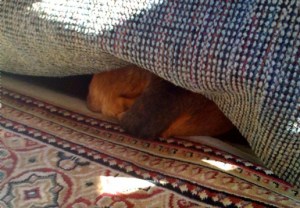
This is a picture of my dachshund Frankie’s butt, taken today, as he hides under a chair during my afternoon practice session. He also passes gas at every lesson.    

What my dachshund thinks of my playing.

What my dachshund thinks of my playing.

Endurance –>

Gizmos

Even though I know better, I keep trying out things that I hope will instantaneously turn me into the world’s greatest horn player. The two latest gadgets that I am trying out are the Dennis Wick Horn Booster and the AcoustiCoil.

The Denis Wick horn mouthpiece booster is said to, among other things, add more mass to the mouthpiece to help with projection, provide better control at louder dynamics, and better centering of pitch. Oh I wish this was true. I have tried it on and off for the past three months or so. I keep hoping that it will help but I really can’t tell much of a difference other than it makes certain notes buzz. Because of this buzzing I would use it for around a half and hour and then take it off and then try it again later in the day or the next day. I’m not 100% sure that it fits my mouthpiece correctly but I’m using a B12 Moosewood cup and that’s pretty standard.   

The AcoustiCoil is supposed to enhance everything – per their website: articulation, endurance, dynamics, intensity, intonation and range – yup, pretty much everything. Rather than my paraphrasing what their website says, please just check it out. If nothing else, it’s an interesting premise to read about. I have had slightly better results with this than with the Denis Wick Horn Booster.

The first time I used it I went straight to band rehearsal. I immediately noticed better articulation. In fact, I probably played the band music as well as I had ever played it at this rehearsal. I practiced with it in my horn for a few days but as the time passed I noticed less and less improvement – in other words, I played the way I always play. I would then take it out of the horn and it would seem that I played better without it but again eventually I would drift back to my typical capability. I’ve had it in my horn for two or three week stretches because I forget that I have it in. During those stretches I’ve had great days and horrible days. So the jury is out with this gadget. 

Of course (here comes the disclaimer) the results that I have obtained are exclusively mine. I’m not saying that these gizmos don’t work, they just didn’t work very well for me. It’s entirely possible that both these devices would work better for someone who plays better than I do. Most likely the expected changes are subtle and would more likely be noticed by an experienced player. Although I will always be a sucker for the latest gizmo, the real deal is that I will just have to keep on practicing.

International Horn Symposium –>

Two teachers

A few days ago I posted (A lesson in basics) about my grueling lesson with Scott Bacon who I take lessons from monthly. Thursday I had my weekly lesson with Lynn. I reviewed my lesson with Scott pointing out the specific things I wanted Lynn to watch for. In general I work on very, very specific exercises with Scott along with one piece of music that Lynn and I are working on if there is time. In my lessons with Lynn we go over the exercises I work on for Scott and then spend a lot more time on music. 

Lynn and I started with the low arpeggios that I always warm-up on. Low C – middle C – G – middle C – back to G and then down to C. This is the exercise that Scott stopped me about half way thru and said that I was closing my throat. It’s described in a bit more detail in A lesson and practicing. I worked on it a lot between Monday and Thursday and Lynn watched me carefully as I progressed up to third space C and back. She didn’t see me close my throat (phew) as I got higher but she did say that I am working too hard. I wasn’t really sure how to work less hard but I got it during the next exercise. 

After the arpeggios we worked on Singer exercise #4. The goal is to play the four note slurs (G-A-B-C; then A-B-C-D, etc.) as smoothly and evenly as possible. We spent some time doing this sequence on the mouthpiece only. This got me to relax, not work so hard (I got it), and just blow a nice even airstream. As you go up in the scale more air is needed but the volume and the smoothness has to remain the same. The exercise went much, much better back on the horn. 

Here’s the big advantage of working with two teachers. Scott talked about what he wanted me to accomplish from the exercise. I played the exercise over and over at Scott’s and eventually I got to ‘very good’ and ‘that’s what I’m looking for’ comments from Scott. The problem for me was that I really didn’t know exactly what I did to get to ‘very good.’ I could hear that I was playing the exercise much better. I know the goal but getting to the goal, not so much. 

Lynn provided the tools that got me to play the exercise correctly consistently. The same thing was true with Kopprash #2. Scott told me what he was looking for (this was my third lesson on Kopprach #2). 1 – enough air to get thru the phrase; 2 – legato tonguing; 3 – impeccable rhythm; 4 – very controlled dynamics starting from pppp and getting to ffff, as loud as I can possibly play, at the exact places in the music where the crescendo starts and stops. I never got even close to a ‘very good’ at Scott’s. Lynn had me start at the last three notes and play them as loud as I could. Then we went backwards. This way I learned how loud I needed to get and how much air it took to play those notes, my two biggest problems with this exercise. 

Scott also has techniques that helps me with the music I’m working on with Lynn. For example, (and this is just one of many) he taught me to set the metronome at double time to work with my rhythm issues. One interesting note about the metronome. Lynn and I discovered Thursday that once I learn the rhythm with the metronome, I actually play more spot on with the metronome off than with it on and I feel like I play a whole lot more musically. I would never have realized this at Scott’s since the metronome is never off. (Ugh.)

Fortunately for me, Scott and Lynn were able to meet each other and spend a bit of time talking at the Southeast Horn Workshop. It’s nice to know that when I say ‘Scott said this’ or Lynn said that’ at a lesson that we all know each other. It’s also good that inevitably if I say ‘Scott said this’ or Lynn said that’ that the response is always, ‘good.’ This two teacher thing would never work if I was getting conflicting advice. I think I’m learning a lot faster by having both teachers and I’m very happy that, so far, this is working well for me.

Gizmos –>

A lesson in basics

You’d think that after a year I’d be past needing a lesson in the most basic parts of horn playing. Alas, such is not the case. Yesterday I had my monthly lesson with Scott Bacon and it was illuminating to say the least. I was there for about three hours and we covered some warm-up exercises, Singer exercise #4 and Kopprash exercise #2. 

Between my lesson last month and yesterday, unbeknownst to me, I’ve adopted some bad habits. I started my lesson with the low slurs that I do to warm-up.  These start on the C below middle C and go C – up to G – back to C then C – G – up to middle C – and back and so on up to hopefully, for me, third space C. Well, I got to C – G – C – E – C – G – C and Scott stopped me. I was closing my throat to force myself to get to the higher notes. I wasn’t using air properly. We went back to just the first C – G – C so I could understand what my throat feels like doing it right and then continued on. Eventually I did it correctly.

It’s hard to describe what this sounds like when it’s wrong but it’s sort of like a huff into the higher note instead of a smooth slur. I was not doing this last month and I didn’t realize that I had started doing this until he pointed it out. Lynn, my weekly teacher, noticed last week that I was doing this a bit on the highest notes when starting arpeggios on middle C but I hadn’t realized that I was doing it on the low slurs.  Because I warm-up on my low slurs before my lessons with Lynn begin, she wouldn’t have noticed the problem on the low stuff. 

Scott and I then moved on to exercise #4 in the Singer book. This seems like a very straight forward exercise. Start on G on the staff and slur quarter notes (quarter note = 60) up from G to A to B to C, repeat and then smoothly drop from C to A and go from A to B to C to D, repeat, drop back to B and go to E and continue this pattern all the way up to high C if possible. To do this exercise correctly, the notes need to be dead on with the metronome, even in volume, rich in tone, with seamless transitions from note to note. Breaths need to be planned so they don’t happen during the four note slur. For me, this whole exercise is hard. Really hard. What’s worse is that Scott will say, “do it again, do it again, do it again” for what seems like endless attempts. Then he’ll say, “yes, that’s better” and even an occasional “very good’ and I can’t always tell what it is that I have done to get there. 

Somewhere in the middle of this exercise he stopped me, asked me to stand up, and we worked on posture. Another area where I didn’t realize I had a problem. He stood me in front of a mirror, had me balance properly and hold the horn differently that I had been. In particular he wanted the lead pipe in line with my sternum and tilted down a bit more than I was doing. Then, while I’m standing there, we started on this exercise again. I did it over and over as he repositioned my body. Well, amazingly enough, it got easier and easier to do it right. This was a real eye-opener for me. The changes in my posture were subtle and they made a really big difference. The next challenge was to take this new posture and make it work sitting down. We went through the same playing and positioning routine and I got to the point where I could play the exercise while seamlessly changing from bell on the knee, off the knee and standing. I hope that I can remember enough to continue doing this right. This would have been a great time to have a video camera, or at least a recorder, at a lesson.

What can I say about Kopprash #2. Sigh. Scott expects the same diligence (rightfully so) with this exercise as he does with the Singer exercise. Add to that musical phrasing. Rhythm must be impeccable. Missing a few notes here and there is not the issue. It’s putting the whole package together – rhythm, phrasing, precise dynamics, breathing – that’s important. He has me play 16th notes for each quarter note to try to get the precision he is looking for. I think we spent at least a half an hour just on the first phrase – 4 measures. My assignment for next month is to just get this phrase and the next phrase of 4 measures as close to perfect as I can. 

I also talked to Scott about the intonation of my horn. If you’ve been reading some of my posts you know that I find the horn to play sharp, especially third space C. Well, Scott played my horn a bit while I had the tuner on and, of course, he played in tune. He made some adjustments of the tuning slides and then I tried the horn again. Murphy’s law kicked in here and I couldn’t play that darn C out of tune. Problem solved? Hardly. I got home and tried the horn and the C was as sharp as ever. I’m not talking just a tad sharp, it’s halfway on the tuner to C#. Easily hearable to anyone who has any kind of ear. 

If I’ve learned anything from this ego-bashing experience, it’s that it is just not possible to learn to play this beast of an instrument decently without a teacher. I was developing new bad habits even after playing for a year. Heck, I’ve got two teachers and I still developed these bad habits.

I know the notes. It’s all that goes into the notes to make music that requires a teacher. I would never have discovered the posture issue. I would always be sloppy with rhythm. I just don’t notice it if I’m slightly off when I’m playing by myself. I am a master at avoiding the metronome entirely and when I use it, completely blocking it out of my consciousness. When I’m practicing I don’t notice all the little things that need to be better. When I play back recordings of myself I can hear all these things that need work but often I don’t know what to do to correct them on my own. I’m very thankful that I have the luxury of having good teachers close by and of being able to afford to take lessons.

Two teachers –>

Practice gone wrong

I don’t have any answers for why I occasionally have very bad practice days. I actually don’t have any answers for why I have very good ones either. I’m just very happy with the good ones. It’s probably worth examining both sides in an effort to try to learn what’s going on. 

Yesterday morning was one of those very, very bad practice sessions. It started out okay which they usually do. I always start my day with low register warm-ups and I can’t remember the last time I had trouble with those. I’ll get an inkling that maybe I’m going to have a bad day when I start the arpeggios from middle C and my chops feel a bit stiff and the tone is off. I’ve started off like this and ended up with a really good day so it’s not a sure thing that it will be a bad day which is good because I don’t want to end up talking myself into a bad day by over judging the first half hour of practice. 

I get more than an inkling about the day when I start on the Kopprash exercises. I know from keeping pretty copious notes what I would consider a baseline for each exercise. I establish my baseline when I first start working on an exercise. The first baseline is just reading through the exercise. It doesn’t matter how bad it is. If I miss almost all of the notes I’ll rate it a 1 or 2 on a scale of 1 to 10 and whatever that number is it’s my beginning baseline. As I work on the exercise that rating goes up as I improve usually to a 6 or 7. A 7 would be decent. Once my baseline gets to a 7 then I feel like I’m having a bad day when I give that exercise a 4 and a good day when that exercise gets a 9. If that same exercise starts getting 8’s and 9’s consistently then that’s the new baseline and dropping to a 6 or 7 would be a bad day. I’ve never given myself a 10 but I have some 9.5’s.  

I don’t consider any day a bad day if it’s only one or two exercises that get lower ratings. It’s when they are all down for the day that it becomes a bad day and if they are significantly lower then it’s a very bad day. Yesterday my 7’s were 2’s and 3’s. There was even a 1. I couldn’t even get the notes out. Yesterday this wasn’t just true for the Kopprash exercises, it was true for everything I tried to play. So it’s officially a very bad day.

The question is why. What’s different, if anything, to cause a day like this or, for that matter, a really good day? Last week I talked about a bad day after two evenings of band rehearsals without my usual practice routine before them. I did have a band rehearsal last night but this time I did my usual warm-up routine in the morning. I had no problem with chops at rehearsal. 

At first glance, it does point to the day with a band rehearsal as a possible culprit. However, I looked through my notes and I have had stellar days after band rehearsals. The only difference is that I practiced for a whole hour before those rehearsals and I ran out of chops at rehearsal. Could it be that not practicing enough is the problem? My notes do lead to that conclusion both for good days and bad days. 

What about other things? I didn’t sleep well Tuesday night. Hmm. Unfortunately I haven’t been documenting my sleep patterns in my horn notes. Maybe I should. What about nutrition? I am continuously on a diet so I don’t think that has any impact. I eat almost the same thing everyday. Exercise? That could have some relevance. Circulation is important for hornists and my exercise habits have been sporadic at best. Another thing that probably should be added to my notes. 

There’s always some discussion on the forums about drinking something hot or cold after practicing. Well I tried both yesterday during breaks and I didn’t notice any difference. I usually have a cup of tea during practice breaks but again, that’s not something I’ve been writing down. 

Then there’s proper breathing and posture which I try to pay attention to when I practice, especially on a bad day. I also wonder if I’ve unconsciously changed my embouchure just slightly.

These are all questions I have no answer for. The one thing I do know is that the more you have written down, the more likely you are to be able to analyze problems. Hopefully, today will be a better day.

A lesson in basics –>