Goals

When I first picked up my horn again back in May 2008 I really didn’t have any expectations or goals. I was just going to see how it would go. As I played and then actually started to practice I slowly got better and good things fell into place. I didn’t set a goal to play in a community band by January 09. One day my teacher and I talked about playing in a band and I found a local group, emailed the band director and got in. Then I met the other hornists in this band who told me about another band and I got into that.

As I practiced more and played better I got more serious about playing and I started to think very abstractly about what goals I have related to playing the horn. Goals can be short term or long term and may or may not be achievable depending on how they are defined. Fundraising goals, for example, are typically set for a fiscal year which, to me, would be a long term goal.  Establishing targets for each quarter would be short term goals. To reach a short term goal one can define a set of tasks which, if accomplished, completes the goal. On a daily or weekly basis one can identify expectations that hopefully lead to successfully completing the task. A task could be contacting all the people who made a donation the previous year with an expectation of getting 65% of them to donate again.

For horn playing, one of my short term goals is to learn transposition. The tasks would be to learn Eb and then E and so forth. As I practice everyday I may set an expectation of playing one short Kopprasch etude correctly in Eb at a given tempo, say quarter note = 60. Once I achieve that, the next expectation would be to play the same exercise at quarter note = 70. This may seem like micromanagement but as I mentioned in my blog about expectations I want to make daily practice sessions a positive experience so I want to set my daily expectations darn close to achievable. As I work on transposition over time my short term goal will ultimately become an expectation – e.g. play x number of excerpts in different transpositions correctly.

A long term goal of mine would be to play in a community orchestra. One of the many things I need to do to achieve that goal is to learn transposition. So that long term goal of playing in a community orchestra is made up of shorter goals, one of which is to learn transposition. Another thing I have to work on is rhythm. I think most goals should be quantifiable so a goal of “get better at rhythm” would not be a particularly useful goal. Picking out a rhythmically complicated excerpt to be sight read in a month might be a better goal.

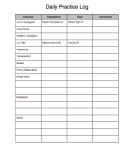
I hadn’t really thought about writing my goals down but it makes sense to do that just as it makes sense to write down expectations. To that end, I designed a practice log that hopefully will make it easy to jot down notes (pun intended) as I practice. The value of a practice log is not only to identify what one should work on for the day but to see progress on a regular basis. The more specific and achievable the expectations are the more obvious it will be to see improvement.

Practice Log

Practice Log

This is the log I designed and just started using. I typed in the exercises that I do everyday and I left blank space for the current things I am working on that will change over time. I entered a few expectations and goals as an example. I think this log still needs some improvements – a place for a date; maybe using landscape format to get more room for comments or to add a column for tasks. It’ll need to be two pages to get everything in it but that’s probably the better way to do it. Once I feel comfortable with the design I’ll take it to Staples, print up a hundred or so pages and have it bound.

I’ve been keeping a practice journal for quite a while now but I rarely go back and read it. For one thing, my handwriting is awful so when I do look it over I can’t figure out half of what I wrote. At my weekly lesson we sometimes review what I have written for the week but I lose some valuable lesson time trying to decipher what’s in the journal. Even if I can figure out what the words are I don’t always remember what I meant. This log needs to be simple and concise so it’s easy to go back and review it. If anyone has ideas on how to make this log better I’m all ears (or maybe eyes.)

What’s age got to do with it? –>

Expectations

I had one of those “It’s 2 AM in the morning, why on earth am I awake?” nights and I started thinking about expectations. (It’s amazing what pops into one’s head in the middle of the night.) I spent 24 years in corporate marketing before I retired and I spent many of those years dealing with performance reviews based on expectations.

The typical review was based on ‘below expectations’, ‘meets expectations’, and ‘exceeds expectations’. These, of course, were one’s boss’s expectations. How they were derived were more about how much your boss liked you or what the corporation set as a required bell curve for reviews than how well you did your job. This is because expectations are highly subjective and very difficult to define concretely. I remember one time where I felt I had a stellar year and got a ‘meets expectations’ review. I talked to my boss and he agreed that I had a stellar year but then said, “I expected that of you.”

There are ways to try to quantify expectations – e.g. ‘put together 4 marketing kits for the year’. Well, if you put together 5 did you exceed expectations? Only if your boss thinks so. Maybe he would expect 6 in order to get an ‘exceeds’ expectations review.

So how does this relate to playing the horn? I think how ‘good’ we are is based mostly on expectations. For a pro there is a standard of expectations that needs to be met to get that gig or to get an orchestra job or a teaching position. Who defines what that standard is? The person or group who is doing the hiring. They may expect a candidate to play musically as most important and not mind a missed note or three. (Hopefully.) Or they may base everything on technical capability. They may even reject a candidate because he/she is too good and they expect that the person will leave soon for a better position. Did the person who gets the job ‘exceed’ their expectations? Probably but you’ll never know.

For the amateur I think expectations are more personal. There can be the same audition judging expectations for the community orchestra but many times our expectations define a ‘good’ practice day from a ‘bad’ one or a good horn solo in the orchestra from a bad one. You may think you didn’t play your best but the audience, with entirely different expectations, thinks it was wonderful.

When working with a teacher, I think it’s probably a good idea to talk about expectations. Rather than thinking your teacher expects you to play something perfectly (which is impossible) they most likely expect you to just improve. If they assign ‘this, this, and that’ find out what their expectations are. Maybe for the next lesson they just want the dynamics correct and don’t care so much about getting all the notes right. If they assign the Ab major scale most likely they expect you to know it by memory at the next lesson. But find out.

I usually write down how I think I did as I practice but it occurs to me that it might be beneficial to first write down what I expect of myself for my practice session. Maybe it’s just playing four measures of a piece I’m working on without any clams or playing the first two lines of a Kopprasch exercise without missing any notes. Whatever it is it needs to be realistic or I’m just setting myself up for failure and guaranteeing a ‘bad’ day. If I can come up with a reasonable set of expectations and accomplish them – the more specific I make them the easier it will be to determine if I accomplished them – then I can walk away from a practice session feeling good. There will always be days when I don’t meet my expectations but at least I’ll have a solid reason for why it’s a bad day and a goal to do better the next day. Maybe I’m preaching to the choir but that’s what happens with ideas formulated at 2 AM.

Goals –>

Summer season finally over

With the exception of a band concert on the beach on Saturday my summer schedule of weekly rehearsals followed by weekly concerts for both of the bands I’m in is finally over. Phew. Add to that my trips to IHS and the Barry Tuckwell Institute (BTI) it’s been quite a summer. Then there’s the weekly lessons with Lynn and the monthly lessons with Scott Bacon. I have not had much time to actually practice.

My drive back in June from IHS took longer than it should have so I didn’t play my horn for about six days. That resulted, strangely enough, in a big improvement in my playing ability. This improvement lasted for a week or two and then I went to the BTI. I had a fabulous time there but since then my chops have been shot. I have not recovered yet from playing for more than three hours each day.

I’ve tried cutting back my playing time to about an hour from my previous, before BTI, two hours of daily practice. I’ve skipped days here and there. I’ve spent a lot of time practicing long, low notes and easy arpeggios. Nothing is really helping. I’m pretty sure that my band schedule isn’t helping the situation because we play fff almost all the time. Rehearsals run from an hour and a half to two hours and the concerts are an hour.

I’ve managed to barely maintain the level of technical capability I reached since IHS but my tone is pretty bad. It’s fuzzy and screechy. This is my typical problem when I’m having a bad day and I know I’ve mentioned it many times before. Then there are days when I just can’t play anything. I’ve always had bad days here and there, even two or three in a row. I think this current spell of bad days sets a record for me. It’s been three and a half weeks of poor to mediocre playing and no endurance. I’m dealing with this pretty well I think. I’m not rushing out to change mouthpieces or trying to find some gadget that will cure all. I haven’t changed my warmup routine. I’m more annoyed than frustrated. Enough already with this.

I am hoping that when I get back into my normal routine of practicing that this bad spell will get go away.  It’s way more fun to practice when I’m playing at the level of my expectations. If another week goes by without any improvement then I’ll have to dive deeper into what’s going on. Right now I’m still calm.

Expectations –>

David Amram

This is a very long post (which I am now making even longer) but I didn’t want to edit what David Amram wrote. I hope you find his composition and program notes as enjoyable as I did.

I had the pleasure of re-connecting with David Amram at IHS. I had met him many years ago when he studied composition with my mother. At IHS David Amram led a jazz improvisation class that was just superb. Before IHS I hadn’t realized that he played the horn. He also spent some time in Scott Bacon’s booth where he and Rick Todd improvised for at least an hour. What a treat that was!  After this I was able to spend some time talking to him both about his time studying with my mom and what he’s been up to for the past thirty years to which all I can say is wow. David’s a brilliant composer and a truly interesting guy.

Recently he emailed me and provided a link to his 32 minute orchestral work, ‘Symphonic Variations on a Song by Woody Guthrie’, which was commissioned by the Guthrie Foundation. The link leads to a Symphony Silicon Valley world premiere of this piece. I really enjoyed it and decided to share it with my blog readers. The following program notes are written by David.

=====PROGRAM NOTES AND REVIEWS FOR Symphonic Variations on a Song by Woody Guthrie

NOTES FROM THE COMPOSER for
Symphonic Variations on a Song by Woody Guthrie

It was forty-nine years ago, on a cloudy afternoon in 1956 on the Lower East Side of New York that I first met Woody Guthrie. Ahmed Bashir, a friend of Charlie Parker, Sonny Rollins, and Charles Mingus (with whom I was playing at that time), took me over to meet Woody at his friend’s apartment a few blocks from mine.

Woody was lean, wiry, and brilliant, with a farmerly way that reminded me of the neighbors I grew up with on our farm in Feasterville Pennsylvania during the late 1930s. In the late afternoons after long hours of work, they would often congregate to chew the fat in the side room of Wally Freed’s gas station, across the street from our farm. I used to get fifty cents to mow Wally Freed’s lawn and when I was done and stayed around the gas station, I never got caught while eavesdropping on all the conversations of the local farmers and out-of-work men who would commune at Wally’s for their late afternoon bull sessions after their chores were done. They always told it like it was, without wasting a word or a gesture, leaving space for you to think about what they were saying, and in spite of the grinding seemingly endless horrors of the Great Depression, they had better jokes and stories than most professional comedians or politicians. Woody had this same quality, and I felt at home with him the minute we met.

As Woody, Ahmed Bashir, and I sat swapping tales and drinking coffee at the tiny kitchen table from noon until it was dark outside, Ahmed and I spent most of the time listening to Woody’s long descriptions of his experiences, only sharing ours when he would ask, “What do you fellas think about that?”

The rest of the time, we sat transfixed as he took us on his journeys with him through his stories. Woody didn’t need a guitar to put you under his spell, and you could tell that when he was talking to us, it wasn’t an act or a routine. Like his songs and books and artwork, everything came from the heart.

Looking back at these memorable first few hours with Woody, I still remember the excitement in his voice, as if he himself were rediscovering all the events and sharing them for the first time, as he told Ahmed and me his incredible stories of his youth and subsequent travels. Both Ahmed and I marveled at his encyclopedic knowledge of all kinds of music, literature, painting, and politics, which he wove into his narratives, all delivered in a poetic country boy style that was all his own. During these descriptions of his travels and adventures around the country, he often included references to events of his early boyhood days in Okemah.

Ever since that day we first met a half a century ago, I have always hoped that someday I would get the chance to go to his hometown of Okemah, but with my crazy schedule I never had the opportunity to do so. Shortly after Nora Guthrie asked me to compose this piece to honor Woody’s classic song, I was invited to perform at WoodyFest, the annual summer festival in Okemah. I have now done it for the past three summers.

In his hometown, I was able to meet his sister Mary Jo, her late husband, and Woody’s remaining old friends from long ago who were still living there. And by playing music and spending time with people who were also natives of Okemah, I felt that I was able to better understand Woody and his work in a deeper way.

I was now able to make a connection, since that first meeting with Woody half a century ago, to the ensuing years during which I have played countless times with his old friend Pete Seeger and his protege Ramblin’ Jack Elliot, and times spent with Woody’s late wife, Marjorie, and the numerous concerts I have participated in with his son, Arlo, over the past thirty-five years.

All this helped me when writing Symphonic Variations on a Song by Woody Guthrie.

The opening Theme and Fanfare for the Road has the percussion introduce the actual theme played by the marimba, followed by a fanfare, expressing Woody’s desire to go out on that open road.

Variation l Oklahoma Stomp Dance, is my own melody, depicting Woody attending a nearby Pow Wow and hearing an Oklahoma Stomp Dance of the Western Cherokee, on a Saturday night through dawn of Sunday morning. During the dance, slightly altered versions of the Theme appear, as they do in almost every other variation. The variation ends quietly, joined by fragments of the initial fanfare, blending with the Stomp Dance.

Variation ll Sunday Morning Church Service in Okemah is a musical portrait of by gone times. The oboe, clarinet and harp introduce a mournful melody, restated by the strings, and the theme is heard, as Woody heard it in church played on the organ, but with extended harmonies. The theme is later stated by the English horn and harp and traces of the fanfare are woven in with the first melody and distant church chimes are heard as the variation ends.

Variation lll Prelude and Pampa Texas Barn Dance is the beginning of Woody’s journeys from Oklahoma through America. The solo violin introduction to the dance is followed by the double reeds, indicated in the score to sound like Celtic Uilleann Pipes. A lively original melody, composed in the style of Irish folkloric music, is later joined by the trombones and tuba, playing the theme as cantus firmus, in an extended version beneath the dance melody itself.

Variation IV Sonando con Mexico (Dreaming of Mexico) is a musical portrait of the Mexican workers with whom Woody spent time, and about whom he wrote some of his most memorable songs. The opening trumpet call, marked in the score to be played cuivre ed eroico, al torero (brassy and heroic, like a bullfight ceremony) is followed by a nostalgic melody in the strings, suggesting the workers dreaming of their home and families south of the border. The melody is developed and leads to a tuba solo, reminiscent of the Mexican polkas played by folk ensembles throughout the West. The principal song-melody returns, with the theme reappearing in the horns, weaving through the Mexican song as an obbligato, showing how Woody could not get this melody and the idea for the song out of his mind.

Variation V. Dust Bowl Dirge, for strings alone, honors the brave people who survived the national nightmare of losing everything during this ecological catastrophe and still found a way to survive. One of Woody’s greatest songs, “So Long, It’s Been Good to Know ‘Ya” was reportedly written as a farewell note during one of the terrible storms when it was feared that everyone present with him would suffocate. This minor variation of the theme is played by the violas and then restated by the whole string family.

Variation VI Street Sounds of New York’s Neighborhoods is a compilation of many kinds of music that Woody loved to hear when walking through the neighborhoods of Manhattan and Brooklyn, during an era when music was played everywhere out of doors during the warm seasons. We hear the lively sounds of a Caribbean Street Festival, with the rhythms of the West Indies,Cuba, and Puerto Rico, and the theme appears in counterpoint in the middle of the march. this is followed by a Klezmer Wedding Celebration and the festive sounds of a middle Eastern Bazaar, where again the theme is used with the exotic sounds of Greek, Turkish and Armenian music superimposed over it. We ten hear the brass family play a hymn-like version of the theme (again using harmonies far from the three chords of the original song) evoking a Salvation Army band, which was a fixture on many corners of New York City’s neighborhoods during the late 1940s.

The same harmonies are used for a short section entitled Block Party Jam, often an occurrence to welcome returning veterans of World War Two to their neighborhoods, where jazz bands played celebratory as well as innovative music.

Finally the theme returns in a stately fashion with the original fanfare of the road playing in counterpoint, followed by a rousing conclusion restating the opening of the piece and a triumphant ending.

Just as in the case of Beethoven’s’ Symphony No. 6 in F major Pastorale, where he titles each movement with a brief description, the program notes for Symphonic Variations on a Song by Woody Guthrie serve as a guide to listener but are not essential to enjoy the piece.

The biographical nature of Symphonic Variations on a Song by Woody Guthrie, served as a point of departure to write the best piece that I could, just as Hector  Berlioz did when composed Harold in Italy, inspired by the life and times of Lord Byron.

I receved invaluable  help from the research provided by Nora Guthrie, as well the inspiration when performing the song  in concerts over the years with  her brother Arlo, All this helped me to write the piece. I also thank my children for understanding why I often seemed to disappear for long stretches of time while putting in endless hours day and night to complete this new piece. And I thank Woody Guthrie for sharing his gifts with the world, which enables all  us today to feel welcome in those pastures of plenty which he sang to us about. This piece is a thank you note to him for all the joy his spirit still gives to people all over the world.

Summer season finally over –>

Blog not

I’ve been more silent than usual this week. For reasons mostly involving my adult children, I am switching from a MacBook to a MacBook Pro. (Thank you Apple for obsoleting my new MacBook four months after I bought it. Thank you Holly for needing a laptop.) I have been painfully backing up my MacBook at the expense of writing my blog and doing my usual two hours of practicing. (Aside to Julia Rose – this is not nearly as much fun as a new puppy.)

Some of you computer types may be wondering why I didn’t just back up my MacBook and restore it on my MacBook Pro. Well…I’m one of those try everything people and the MacBook has gotten quite slow. iCal, for example, takes close to a minute to open up. I decided that it was a much better idea not to put all the old junk on the new MacBook Pro.

Add to that the fact that Holly will be taking the MacBook away before the new one arrives. This necessitates my use of my old PC laptop that has, despite two trips to HP for repair, a bad video module resulting in the blue screen of death appearing every fifteen minutes or so. Ugh. Transferring files is a pain in the butt.

Coming up shortly – a post mostly written by David Amram. (Thank you David.) At least there will be something to read, music related but only marginally horn related, until my computer hassle is over with.

David Amram –>

Chops etcetera

I am still dealing with some chops issues. It seems to be an inconsistent problem  – Monday no good, Tuesday so-so, Wednesday fine, Thursday awful, Friday back to so-so. Thursday was so bad – couldn’t play anything below middle C that didn’t sound like my dog farting – that yesterday Lynn, my horn teacher, and I worked on long tones and easy slurs for about half my lesson. I would describe my lip as squirrelly. Sometimes it was okay and other times the lower notes were right on the edge of my upper lip failing.

I’m much better at dealing with this sort of stuff now than I was several months ago. I know that I have good days and bad days and that ultimately I will play even better because that always seems to be the pattern. I go through bad spells and then miraculously I get a lot better. It’s frustrating going through the bad spells now mostly because I don’t accomplish what I want to when I’m practicing. When my chops aren’t behaving everything gets sloppy, including me. Today Lynn noticed that I was slouching in my chair and not breathing properly. I didn’t realize it but I was in the mode of ‘I’m playing sucky, so I’ll just sit sucky and breathe sucky too.’ We did some stretching exercises and some breathing exercises which helped my playing quite a bit and my attitude a whole lot. There’s nothing like sitting up straight to refresh one’s brain.

BERP

BERP

At today’s lesson I also worked with a BERP (Buzz Extension Resistance Piece). Lynn recommended it way back when I first started lessons but at that time I could hardly buzz so the BERP got put into a drawer and forgotten about. What a difference now. I played arpeggios on the BERP first and then played them on the horn. They were instantly better. It was a wow moment. Much smoother and louder. I have problems playing loud so now I have a tool that can help with that and a whole lot more. When I first bought the BERP I didn’t really understand what the point was. Now I get it. Big time. The BERP has earned its place on my leadpipe and will remain there. It’s a good gizmo!

Speaking of gizmos, when I was at IHS I bought a stem weight, also called a donut, from Tom Greer. According to Tom’s website it “cuts down on the ‘radiation’ of high partials from the leadpipe, enhancing projection and tone quality.” When I tried it at IHS Tom said I sounded more centered. I use it more often than not and I do think it makes a positive difference though it’s subtle. They come in different sizes so if you get one make sure it fits on the mouthpiece.

I also purchased a Body Beat metronome back in May. Those of you who have read some my earlier posts know that I can easily block out the beat of the metronome which is especially bad for me since rhythm is not one of my strong suits. The Body Beat sends a pulse down a wire that is clipped on to clothing next to the body so you can feel the beat. This actually helps me a lot. At my last lesson with Scott Bacon at the end of June he said my rhythm was the best he’d heard it. It is a bit of a pain in the butt to use and it’s gone flying off the music stand if I get up and forget to unclip it. I think it’s a good tool for anyone struggling with a standard metronome.

Blog not –>

Chops

I don’t have any.

I thought I recovered from the three hours of playing every day at horn camp at the beginning of last week. I got home a week ago Saturday and went straight to a band concert. Chops were good. I put in two hours of practice Sunday – chops were still good. But….band rehearsal last Monday night – ugh – no chops. I backed off practicing to about 40 minutes a day but Tuesday – Sunday – still no chops. Last night’s band concert – marginal chops.

The symptoms – very fuzzy, almost screechy tone and no high range. Low range is fine. I commented on my lack of chops on my Facebook page and Tom Greer wrote back “don’t go to horn camp.” Probably good advice but I had way too much fun and will go back again. I have a band rehearsal tonight so I will see if there is some improvement. I’ve opted not to practice today and just spend some extra time warming up before the rehearsal.

I think I’ll cook chops for dinner tonight. Maybe that will help.

Chops etcetera –>

BTI – Wednesday Afternoon

Back in 1969 I met Barry at an event at Dartmouth College and got a signed postcard from him. Amazingly I found this postcard just laying on a shelf in my home office closet shortly after I started playing the horn again. 40 years later! It was almost like a sign saying ‘go play that horn again girl’.

Signed Postcard by Barry Tuckwell

Signed Postcard by Barry Tuckwell

Tina and Barry with Postcard

Tina and Barry with Postcard

At lunch I mentioned to Barry that we met once, which of course he didn’t remember, and asked him if he would mind signing my postcard again. I brought the postcard to the horn choir rehearsal and got it signed along with a picture of me and Barry.

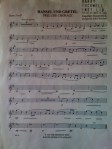
Wednesday afternoon’s horn choir rehearsal was actually our second rehearsal. We did have a rehearsal on Tuesday evening which I forgot to mention in that post. We are playing “Cantos IV: Das Alte Jahr Vergangen Ist, Ein Feste Burg” (that’s a mouthful) by Samuel Scheidt, “Fanfare from La Peri” by Paul Dukas, and “Hansel and Gretel: Prelude – Chorale” by Engelbert Humperdinck. The Cantos is made up of two horn choirs and I played 3rd horn in the second choir. I played 5th horn for the other two pieces.

Cantos IV Music

Cantos IV Music

Fanfare from La Peri Music

Fanfare from La Peri Music

Hansel und Gretel Music

Hansel und Gretel Music

I was very happy that the horn choir music was fairly easy. It made the whole experience of playing in the choir with Barry conducting relaxing and enjoyable, plus we all sounded awesome.

There were two other sessions in the afternoon. One was a master class on the natural horn lead by Jean Rife. I really enjoyed this class. Jean brought several different natural horns, gave some really good demonstrations of the capabilities of the horns, and had some of us try the horns and play some duets with her.

The other class of the afternoon was a faculty session titled, “If only I could…(Fixing those nasty little shortcomings in your horn playing)” led by Mary Bisson. For these faculty sessions we were divided up into small groups so we could really zero in on our specific issues. In the class I was in we worked on lip trills, flutter tonguing, double and triple tonguing and we talked about transposition, sight-reading and nerves.

After dinner we were treated to “An Evening with Barry Tuckwell.” It was wonderful to hear him talk about his career and relay some funny stories. He even spoke about his last performance where he didn’t play the last note.

BTI – Thursday –>

BTI – Wednesday Morning

Wednesday morning we started our jam packed schedule with warm-ups. There was a daily early morning yoga class which I decided not to do. I’m just not into yoga. This decision was probably a mistake since the yoga classes were tailored for horn playing.

Bob Lauver, a hornist in the Pittsburgh Symphony Orchestra, taught this mornings’ warm-up class. Bob wrote the basis of his warm-up on the blackboard and then we went through it in all keys.

Bob Lauver Warm-up

Bob Lauver Warm-up

I struggled with this warm-up for two reasons. One is that I start my warm-up on low C and move down and then up from there. Bob’s warm-up starts on middle C and goes up. I had trouble playing any note above G. Bob wouldn’t even let us buzz on the mouthpiece before we started so I couldn’t even warm-up for the warm-up. The second reason is that I don’t know my scales by memory yet when played at a quick tempo. Yes I know I have to learn them so they just flow off my fingers without having to think about them. I can play all the major scales in the Pares book at a reasonably quick tempo when I’m reading the notes.

After the warm-ups we went to our ensemble groups. I was placed in a quartet that Bob was teaching. Other students were put in larger groups. My first reaction was ‘why me?’ I’ve never played in that small an ensemble and the three other members of the quartet were young students who play distinctly better than I do. Looking back being placed in this group forced me way out of my comfort zone which, in the end, was very good for me.

Debussy Trois Chansons

Debussy Trois Chansons

Riggins Arioso

Riggins Arioso

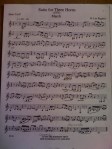
Riggins March

Riggins March

The music Bob picked was “Trois Chansons, 1. Dieu! qu’il la fait bon regarder!’ by Claude Debussy and “Suite for Three Horns: Arioso, March” by H. Lee Riggins. At first glance the music looked quite hard for me – lots of 16th notes which always elicit panic – but Bob assured me that it wasn’t as bad as it looked.

After the first rehearsal I felt a little better about playing these pieces. As Bob said, they weren’t as bad as they looked. Besides that, playing in the quartet was lots of fun. Bob was absolutely wonderful with me. He took the time to help with some of the tougher passages, was really encouraging and had lots of patience. Time for lunch.

BTI – Wednesday Afternoon –>

Barry Tuckwell Institute – Arrival

Last week I attended the Barry Tuckwell Institute held at The College of New Jersey. This was an amazing experience. In fact, I almost emailed my husband and said it was the best thing I ever did but then I decided that probably wasn’t the best message to send. I can say that it was the best horn experience I have ever had.

We all checked in on Tuesday afternoon, got our dorm room assignments, our schedule and our official t-shirts, and then had dinner where we were introduced to Barry. There were about 20 students, four horn teachers, Barry, and Karen – the person that made everything run smoothly. Boy did she do a great job. Everything ran flawlessly the entire time.

We had a nice mix of attendees. There were a few high school students, some college students and the rest of us were adult amateurs. I don’t think that I was the most inexperienced hornist there which was a big relief. I had been very worried that I would not be able to keep up with the other students. I needn’t have been concerned. One’s skill set was completely irrelevant. If all I could do was play a few easy tunes I think they would have figured out a way to include me in the playing events.

No Kopprasch

No Kopprasch

The t-shirts we received set the tone for the conference. I’m a big fan of this t-shirt! Those of you who have read some of my other posts know that although I practice the exercises in the Kopprasch book, I am not a fan. Barry joked that if anyone mentioned Kopprasch there would be a $500 fine. Although I brought my Kopprasch book expecting to do some practicing, I went and shoved it back in my car. What a relief. According to the BTI website, the whole idea of the institute is to experience the joy of playing the horn in a non-competitive environment. They accomplished that in spades. I never felt like I was being judged on my horn playing in any way.

Meeting Barry was one of those goose bump experiences. He has been my horn hero ever since I started playing the horn back in high school. (Which made me wonder who are the horn heros now?) What a nice guy. Totally unpretentious. He made everyone feel comfortable. He ate all meals with us, stayed in the dorms, and was easy to talk to. One of the first things I asked Karen was whether we would be able to talk to Barry while we were there. Well, no worries. Karen said that was one of the big benefits of attending. So true. Next post – day one.

BTI – Wednesday Morning –>